How to Choose a Level 2 EV Charger for Your Garage
Choose a home EV charger that matches your vehicle’s connector, daily driving and available circuit. Pick plug-in or hardwired installation first, then compare cable reach and useful app controls.
On this page (11 sections)
- What should you check before choosing a home EV charger?
- Which connector does your car use?
- How much charging current do you need?
- Should you choose plug-in or hardwired?
- How long should the charging cable be?
- Which home EV charger fits your setup?
- What features matter in a garage?
- What should an electrician confirm before installation?
- How should you set up and care for the charger?
- Which common buying mistakes should you avoid?
- How do you choose the right home EV charger?
Choose a home EV charger that fits your car, replaces your daily driving energy and works with your home’s electrical capacity. The highest-output model is useful only if your vehicle can accept that power and your charging routine needs it.
A Level 2 charger uses a 240V supply. Before choosing one, settle the connection style and mounting location, then compare cable reach and controls.
If you’re still comparing charging speeds, our Level 1 and Level 2 home EV charger guide explains the basic differences.
What should you check before choosing a home EV charger?
Check the vehicle, electrical supply and parking layout first. These decide which models fit before app features or maximum output enter the picture.
Write down these details before asking for an installation quote:
- Your vehicle’s charge port and maximum AC charging rate.
- Your usual daily driving distance.
- How many hours the car stays parked near power.
- The planned mounting spot and cable route.
- Whether you already have a dedicated charging circuit.
Share any plans for a second EV or a different parking space. An installation that reaches only today’s charge port may become awkward when your next vehicle has its port elsewhere.
If you rent, get the property owner’s approval before arranging permanent electrical work. A removable charger still needs a suitable circuit and permission for any changes to the building.
For a broader look at the available equipment, see our home EV chargers guide.
Which connector does your car use?
Choose a connector that fits your actual vehicle, or use an adapter approved for that vehicle and charging combination. Check the owner’s manual rather than making assumptions from the car’s brand.
J1772 and NACS are vehicle connections. NEMA 14-50 describes the charger’s wall plug, so a matching receptacle does not prove the charging handle will fit your car.
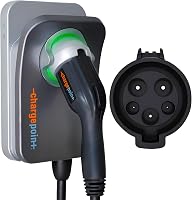
Both ChargePoint options here and the EVIQO use J1772 connectors. Tesla drivers need a compatible adapter for these versions; drivers of other vehicles should check their particular port too.
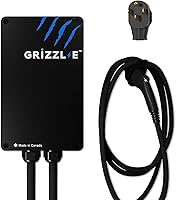
Grizzl-E describes the Classic as compatible with North American EVs and plug-in hybrids. Confirm the supplied connector and any adapter your vehicle needs before ordering.
If you need an adapter, include it in your storage plan. The charging handle and adapter should remain supported rather than hanging where someone could strike them or drive over them.
Our J1772 vs NACS guide explains the difference between the two connections.
How much charging current do you need?
Choose enough current to replace the energy you use between charging sessions. A larger maximum is worth considering when you drive farther, park for fewer hours or have a short off-peak electricity window.
Match home EV charging to your overnight window
Start with your daily energy use and available charging time. If your car uses about 15 kWh during a normal day and stays parked for 10 hours, replacing that energy is a different task from arriving nearly empty before another long trip.
At 240V, 32A provides about 7.7 kW, while 40A provides about 9.6 kW before charging losses. These are electrical power figures, not guaranteed miles of range per hour.
Your car’s onboard AC charger can limit the benefit of a higher-output wall unit. Battery temperature, charge level and the vehicle’s own settings can also affect charging speed.
For a plug-in hybrid with a lower AC limit, extra charger capacity may mainly help a future vehicle. Don’t approve a larger installation solely because the charger’s name includes a bigger number.
Charging is a continuous electrical load, so breaker capacity and charging current are different numbers. The electrician must match the current setting to the whole circuit, including the wiring and connection.
Our guide to Level 2 EV charger amps explains how current affects the choice. For circuit planning, see what size breaker a Level 2 charger needs.
Should you choose plug-in or hardwired?
Choose plug-in for easier removal from an approved receptacle, or hardwired for a fixed connection planned around the charger. An existing outlet is useful only after an electrician confirms its condition and circuit.
A plug-in model suits someone who may move or wants simpler equipment replacement later. Removal still needs to follow the charger’s instructions, and the unit needs proper mounting during use.
Hardwired charging makes sense when you are installing a new circuit and expect the charger to stay in place. It also avoids a receptacle connection and can support higher output when the equipment and circuit allow it.
Do not assume plug-in installation saves electrical work. An unsuitable outlet, shared circuit or poor location can require changes even when the plug shape matches.
Compare a complete installation quote for each approach. A short, practical wiring route may matter more to the project than a small difference between charger features.
Our hardwired vs plug-in EV charger guide covers the trade-offs. If you already have an outlet, read charging an EV from a NEMA 14-50 outlet.
How long should the charging cable be?
Choose a cable that reaches the port with slack along a safe route. Measure with the car parked as you normally leave it, including space to open doors and walk past.
The ChargePoint HomeFlex models have 23 ft cables, the Grizzl-E Classic has a 24 ft cable, and the EVIQO has a 25 ft cable. Compare those lengths with the routed distance, not a straight line through the vehicle.
Use a length of string to trace the path from the planned mounting position to the charge port. Include turns around the car and leave enough slack to avoid pulling on the connector.
Check both forward and reverse parking if you use both. In a two-car garage, make sure the cable works when the other space is occupied.
A longer cable needs somewhere to rest between sessions. Plan broad storage loops clear of tires, garage door tracks and walking paths.
Do not solve a poor mounting location with an extension cord. Read our EV charger extension cord guidance before finalizing the layout.
Which home EV charger fits your setup?
Choose Grizzl-E for adjustable plug-in charging, plug-in ChargePoint for app controls, or a hardwired model for a fixed installation. The right choice depends on the circuit and parking plan you have already settled.
Grizzl-E Classic 40A NEMA 14-50 Charger
The Grizzl-E Classic suits buyers who want a plug-in unit with several fixed current settings. It is a sensible choice when your main goal is routine charging rather than the app controls offered by the other options here.
Its settings pair with 20A, 30A, 40A and 50A breakers, respectively. That flexibility helps when the electrician’s circuit plan calls for less than the unit’s maximum output.
Grizzl-E specifies a metal enclosure and IP67 protection for indoor or outdoor use. The brand also specifies built-in GFCI protection and recovery after a power outage.
Choose it for a straightforward charging routine with a suitable receptacle. Skip it if phone-based reminders and charging records are central to your choice, or if your installation plan calls for higher output through a hardwired connection.
ChargePoint HomeFlex NEMA 14-50 Charger
Choose this HomeFlex if you want removable equipment and ChargePoint’s app controls. The app provides charging information, reminders and smart home connections, so it suits drivers who want charging details on their phone.
This plug-in version requires a 40A or 50A circuit, with output configured to match. Do not confuse the broader HomeFlex family’s 50A capability with what this NEMA 14-50 connection supports.
ChargePoint specifies indoor or outdoor installation and a cold-resistant cable. The company also offers 24/7 support, which may matter if charging is essential to your daily commute.
Pick it when plug-in installation and app features both serve a purpose. Skip it if your car already provides all the controls you need, or choose a hardwired option if your approved plan needs output beyond this version’s limit.
ChargePoint HomeFlex 50A Hardwired Charger
The hardwired HomeFlex suits drivers who want ChargePoint’s app features in a permanent installation. Its adjustable range lets the electrician configure output around the home’s capacity and the vehicle’s needs.
ChargePoint specifies indoor or outdoor use and a cold-resistant cable for this model. Certain functions and troubleshooting steps require Wi-Fi, so check coverage where the unit will be mounted.
Choose it when a fixed connection is part of your plan and you want phone controls, reminders and charging information. Its higher maximum is useful only when both the vehicle and electrical installation can support it.
Skip it if you need to take the charger with you easily when moving. If your car accepts less power, compare the installation work at that lower setting before choosing based on maximum output.
EVIQO 48A Hardwired J1772 Charger
The EVIQO suits buyers who want a permanent charger with energy tracking and useful cable storage. Its app can start or stop charging, set schedules, adjust current and track energy use and estimated charging costs.
The app connection requires a 2.4 GHz home Wi-Fi network. Check that connection at the mounting spot before choosing this model for remote controls.
EVIQO specifies an IP66 / NEMA 4 enclosure and includes a glow-in-the-dark connector holster. The brand backs the unit with a 3-year warranty and provides a side reset button for restarting it without opening the enclosure.
Choose it for app-managed charging and a dedicated installation that meets its requirements. Skip it if you need removable equipment or cannot provide the Wi-Fi connection needed for its connected features.
What features matter in a garage?
Prioritize location approval, easy cable storage and controls you will actually use. More app functions do not help if the cable blocks a doorway or the connection drops at the mounting spot.
For an open carport or outdoor wall, check the entire installation rather than the charger enclosure alone. The wiring route, receptacle if used, mounting surface and connector storage must all suit that location.
An enclosure’s weather designation does not make every installation method acceptable. Our guide to UL and ETL on EV chargers explains what safety certification means when comparing equipment.
For exposed locations, see our best outdoor EV chargers guide.
Smart features are most useful when they fill a gap in your car’s controls. Examples include seeing charging energy in one place, receiving reminders or changing a session without returning to the garage.
Check your electricity plan before creating an off-peak schedule. Lower-cost charging depends on your tariff and charging hours, not simply on owning a connected charger.
Use one main scheduling system at first. A car schedule and charger schedule that disagree can leave a much shorter charging window than you intended.
What should an electrician confirm before installation?
Ask an electrician to confirm available capacity, circuit design, mounting location and the final current setting. Send the exact charger model and vehicle details before the visit.
An empty breaker space does not by itself prove the home can support another large load. The assessment needs to consider the electrical service and other equipment drawing power.
Ask for the quote to identify:
- The circuit and charger output being planned.
- The wiring route and any work needed to reach the parking spot.
- A suitable receptacle or direct connection.
- Permit and inspection requirements where applicable.
- Any panel work needed before installation.
Agree on the mounting spot with the car in position. Place the cable holder where you can dock the handle without dragging the cable across the floor.
After installation, ask the electrician to show you the configured current, disconnect method and normal status indicators. Keep the model information and installation paperwork for future service.
Our EV charger installation cost guide explains what drives the work involved. For the limits of DIY work, read can you install an EV charger yourself?.
How should you set up and care for the charger?
Start with the installer’s approved current setting and the vehicle’s charging guidance. Then arrange scheduling and cable storage around your usual departure time.
If you use app features, complete setup near the charger and check that the phone shows the unit connected. Confirm the time zone and schedule before relying on delayed charging for a morning trip.
Set the car’s charge target according to its manual and your next drive. A larger charging target is not a substitute for confirming that a scheduled session actually starts.
After each session, return the connector to its holder and store the cable in broad loops. Keep it away from tires and avoid closing doors over it or pulling the handle out by the cable.
Periodically look for cuts, cracked parts, damaged pins or discoloration at accessible connections. Stop using damaged equipment and arrange service rather than opening the enclosure or attempting an electrical repair.
Follow the manual for cleaning and care. Keep the connection area free of debris, and avoid directing water into plugs or connectors.
Which common buying mistakes should you avoid?
Avoid buying for maximum output before planning the installation. A well-placed charger with enough overnight capacity is more useful than excess power your car cannot use.
- Assuming a matching outlet is ready. Its wiring, circuit and condition still need assessment.
- Choosing by the vehicle brand alone. Confirm the actual port and adapter requirements.
- Measuring across empty floor space. Trace the cable around a parked car and nearby obstacles.
- Paying for duplicate controls. Check what the vehicle already does before choosing app features.
- Treating an app adjustment as circuit approval. A phone setting cannot increase wiring or breaker capacity.
- Planning around an occasional empty battery. Balance rare long trips against your normal driving and charging window.
If two models meet your needs, compare the complete setup: equipment, electrical work, cable handling and controls. That is a better decision than choosing the largest number on the box.
How do you choose the right home EV charger?
Choose your home EV charger by eliminating models that do not fit the approved circuit, vehicle connection or parking layout. Then decide which remaining features improve your daily routine.
Pick the Grizzl-E Classic for adjustable plug-in charging when phone controls are not your priority. Choose the plug-in ChargePoint HomeFlex when you want both a receptacle connection and ChargePoint’s app features.
Choose the hardwired ChargePoint HomeFlex for a fixed installation with flexible output settings. Pick the EVIQO when its app tools, connector holster and cable reach fit your parking space and connection plan.
Before ordering, have the electrician confirm the exact model and configuration. If your daily driving leaves you unsure about the upgrade itself, read whether you need a Level 2 charger at home.
Frequently asked questions
How do I choose a home EV charger?
Choose a home EV charger that matches your vehicle’s connector, daily driving and available electrical capacity. Have an electrician assess the circuit and connection style, then measure cable reach with the car parked normally; compare app features only after those basics fit, so you avoid paying for functions you won’t use.
Is a plug-in or hardwired home EV charger better?
Choose plug-in charging when you have an electrician-approved receptacle and want easier removal or replacement. Choose hardwired charging for a fixed installation, especially when you need output beyond a plug-in model’s limit; neither choice removes the need to check panel capacity, wiring, mounting location and the charger’s installation instructions.
What size circuit does a home EV charger need?
The circuit must support the charger’s configured output, which is lower than the breaker rating for continuous charging; for example, the Grizzl-E Classic pairs 40A output with a 50A breaker. Have an electrician choose the wiring, breaker and current setting together rather than sizing the circuit from the charger’s name.
Do I need a smart home EV charger?
Choose a smart charger if you’ll use remote controls, reminders or charging records that your vehicle doesn’t already provide. Check the required Wi-Fi connection at the mounting spot before buying; if the car handles your charging schedule well, another app may add little value to your daily routine.