What Size Breaker Does a Level 2 EV Charger Need?
EV charger breaker size commonly follows the 125% continuous-load rule: 40A charging needs a 50A circuit, and 48A charging needs a 60A circuit. An electrician must confirm the charger settings, wiring, panel capacity, and local requirements.
On this page (8 sections)
- What EV charger breaker size matches your charging current?
- Why does a 48A charger commonly use a 60A circuit?
- Does a plug-in charger use a different breaker size?
- Can load management help a panel with limited capacity?
- Which hardwired charger suits your installation?
- What should happen before the first charging session?
- What mistakes cause tripping or unsafe charging?
- Which EV charger breaker size should you plan around?
EV charger breaker size follows the charger's configured maximum current, with common pairings of 40A charging on a 50A circuit and 48A charging on a 60A circuit. An electrician must confirm the wiring, equipment instructions, panel capacity, and local requirements.
Choose the charging speed you need before choosing the biggest charger. A lower current that restores your daily driving range overnight can avoid unnecessary installation work.
What EV charger breaker size matches your charging current?
The common calculation is charging current × 1.25, because EV charging is treated as a continuous load. The result explains typical circuit sizes, but it doesn't select the wiring or approve an installation.
| Configured charging current | Common circuit sizing |
|---|---|
| 16A | 20A |
| 24A | 30A |
| 32A | 40A |
| 40A | 50A |
| 48A | 60A |
| 50A | 62.5A calculated minimum; breaker selection requires review of equipment instructions and code |
A calculated minimum isn't always a standard breaker size. At 50A charging, your electrician must determine the permitted circuit rather than rounding down or choosing the nearest breaker.
Use the maximum current allowed by the installation configuration, not the current shown during one charging session. A vehicle may draw less because of its own limits or charging settings.
How does an EV charger's breaker size affect speed?
The breaker supports a permitted charging load; it doesn't force the car to accept more power. Your vehicle's onboard AC charging limit can make a higher-output home charger unnecessary.
Start with daily mileage and overnight parking time. Our guide to how many amps a Level 2 EV charger needs helps you compare those needs before paying for a larger circuit.
Why does a 48A charger commonly use a 60A circuit?
48A multiplied by 1.25 equals 60A, which accounts for continuous charging. The extra capacity is part of circuit sizing, not spare capacity for another appliance.
A breaker protects the circuit wiring. Replacing an existing breaker with a larger one doesn't increase the capacity of the wires, terminals, or other equipment.
Conductor material, installation method, temperature conditions, and terminal limits affect the wiring choice. That's why a breaker chart cannot give you a universal wire size for every garage.
Keep the branch circuit and the home's electrical service separate in your planning. A correctly sized charger circuit can still add more demand than the service can support without load management.
Does a plug-in charger use a different breaker size?
A plug-in charger follows the same continuous-load principle, with additional limits from its plug and receptacle. A NEMA 14-50 connection commonly supports up to 40A charging on a suitable 50A circuit.
Don't judge an existing outlet by its shape alone. Have its wiring, breaker, grounding, condition, and suitability for repeated EV charging checked before use.
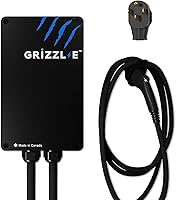
Who should choose the Grizzl-E Classic?
The Grizzl-E Classic suits drivers who want adjustable charging current and a NEMA 14-50 connection. Its settings are 40A, 32A, 24A, and 16A, with a 24-foot charging cable.
Grizzl-E specifies those settings for 50A, 40A, 30A, and 20A circuits respectively. Those pairings don't authorize adapting the plug to an arbitrary outlet or reusing an unsuitable circuit.
Choose it for a suitable plug-in installation where its maximum output meets your needs. Skip it if you specifically need charging above that limit.
Read whether you can charge an EV from a NEMA 14-50 outlet before reusing an existing receptacle. For a new installation, compare hardwired vs. plug-in EV chargers before committing to either connection.
Can load management help a panel with limited capacity?
Compatible load management can reduce charging demand when the home needs power elsewhere. An electrician must assess the system and its installation requirements before treating it as an alternative to a service upgrade.
An empty breaker space doesn't prove that your panel has enough capacity. Existing loads, electrical service limits, and the proposed charger all belong in that assessment.
Who should choose the Emporia Pro?
The Emporia Pro suits homeowners whose main concern is available electrical capacity. It includes a Vue home energy monitor and PowerSmart software, which Emporia says adjusts charging to balance the home's load.
The hardwired model supports up to 48A and includes a 25-foot J1772 cable. Emporia specifies a lower charge rate for its separate NEMA 14-50 configuration, so choose the connection type carefully.
Skip this package if you don't need home energy monitoring or load management. Its extra equipment also needs installation and setup, so include that work in the electrician's quote.
Compare a lower fixed charging limit, managed charging, and any service work before deciding. Our guide to Level 2 EV charger installation costs explains what can change the project scope.
Which hardwired charger suits your installation?
Choose a hardwired charger around your circuit plan, cable reach, and useful controls. Maximum output matters only if your vehicle and electrical installation can use it.
Grizzl-E for an exposed parking space
The Grizzl-E hardwired model suits drivers who want a metal enclosure and connected controls for an indoor or outdoor installation. It has a cast aluminum case, a 25-foot J1772 cable, and output up to 48A.
Grizzl-E provides scheduling, energy statistics, and remote monitoring through its Connect software. Charging also works without an online connection, which is useful where garage Wi-Fi is unreliable.
Skip it if you need a plug-in unit you can disconnect and move. Its included hardwire kit doesn't replace the need to plan the circuit and arrange qualified installation.
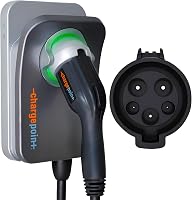
ChargePoint for app-based charging control
The ChargePoint HomeFlex suits drivers who want charging reminders, charging information, and smart home connections through the ChargePoint app. This hardwired model offers an adjustable 16A to 50A range and a 23-foot cable.
Choose it when those app features will help your routine. Skip it if you want a plug-in connection or can't provide Wi-Fi for the features that require it.
All 4 models here use J1772 vehicle connectors.
Check your car's port before ordering, and use our J1772 vs. NACS guide to understand whether an approved adapter is needed.
What should happen before the first charging session?
Have the electrician document the circuit rating and commissioned charging limit. Keep that information with the charger manual so a later app reset or vehicle change doesn't lead to an unsuitable setting.
Before installation, park in your usual position and check the route from the proposed mounting point to the charge port. Allow slack without placing the cable across a walkway or where a tire could crush it.
Ask the electrician to confirm:
- The panel load assessment and any load management requirements.
- The breaker, conductors, connection method, and required protective devices.
- The installation current limit and how it is secured.
- Permit and inspection requirements.
- Cable reach and access to the charger controls.
For most homeowners, the practical question is what work to arrange with a qualified installer. Read whether you can install an EV charger yourself before planning any electrical work.
What mistakes cause tripping or unsafe charging?
Repeated breaker trips call for diagnosis, not a larger breaker. Possible causes include an incorrect current limit, connection problems, equipment faults, or an unsuitable circuit.
Don't remove required ground-fault protection to stop trips. Have the installer review the charger's instructions, connection method, and local requirements together.
Don't rely on a car's lower charge setting to protect an undersized circuit. Another driver, a software reset, or a different vehicle could change that setting.
During normal use, store the connector in its holder and keep the cable clear of sharp edges. Check accessible cable and plug surfaces for damage without opening electrical equipment.
Stop using the charger if you notice a burning smell, discoloration, damaged insulation, or unusual heat. Have the equipment inspected before charging again.
Which EV charger breaker size should you plan around?
Plan your EV charger breaker size around the charging current you need and the circuit your home can support. Ask for the complete installation design before buying equipment that may require more electrical work than expected.
Choose the Grizzl-E Classic for a suitable plug-in circuit, or the hardwired Grizzl-E for its metal enclosure and offline charging capability. Consider Emporia Pro when managing household demand is central to the project.
Choose ChargePoint HomeFlex when its app controls fit your routine and you can provide the needed connectivity. Use our home EV charger guide to compare the wider buying decisions, then revisit Level 2 EV charger amperage to settle on a practical current limit.
Frequently asked questions
What size breaker does a 48 amp EV charger need?
A charger configured to draw 48A commonly needs a 60A circuit under the 125% continuous-load rule. Your electrician must also check conductor capacity, equipment instructions, panel load, and local requirements; a charger capable of 48A may support a lower installation limit, but that setting must follow its instructions.
Can I put a 40 amp EV charger on a 50 amp breaker?
Yes, a 40A charging load commonly fits a properly designed 50A circuit. The breaker alone doesn't establish that the installation is suitable: wiring, connections, and any receptacle must also qualify; have an electrician confirm the circuit and set the charger's installation limit before you begin charging.
Does a Level 2 charger need a dedicated breaker?
A home Level 2 charger generally needs its own dedicated branch circuit; don't assume that an outlet used for another appliance is suitable just because the plug fits. An electrician should check the circuit, charger instructions, and local requirements, including any permitted approach to sharing or managing electrical loads.
Is a 50 amp breaker enough for a 48 amp EV charger?
A 50A breaker generally isn't enough for continuous charging at 48A; the common pairing is a 60A circuit. Some chargers can be installed with a lower maximum current that suits a smaller circuit; that requires an approved installation setting, not simply choosing a slower charging session in the car.